


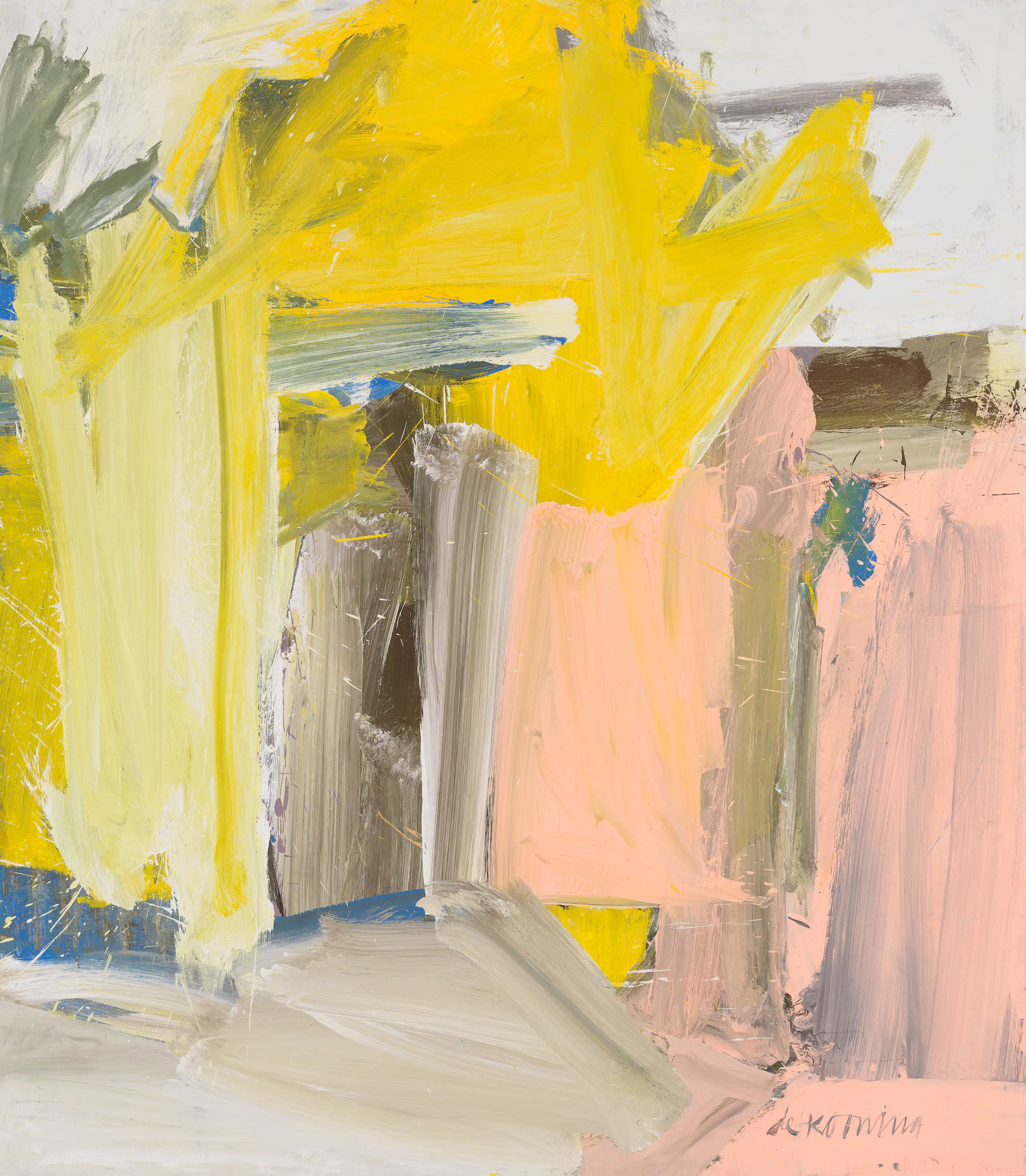
 Door to the River

                            —de Kooning

He means, I think, there's an out

built of these fistfuls of yellow.
Means, I think, there's a door

in this passionate and hard-won
approximation, in this rough push

and lemon smear, this difficulty,

there's—what? In the meadows,
yesterday, great heavy presences

of the trees thinking, rimmed

around the perimeter of the field:
pendulous, weighted, trees

here to be emerald pull
and resistance, suspended

their given hour, the meadow arranging itself

into this huge composition which invites
and resists at once, the world's hung

surfaces: aren't we always wanting
to push beyond it, as if behind the scrim

—old lure and spur, old promise—

lay . . . The bright core
breathing? Why can't you just

love sheer play, these forms'
dynamic irresolutions

on the surface of the day?

These trees may seem still,
fixed their hour in the rush

and suction from that gate:
can't you just walk between the yellow

word field and the green word door
and not demand to penetrate

the primed and stubborn scrim
toward some clarity beyond forms?

Written in a sidewalk's new cement:
Be happy it's all you really have.

Happiness? Our possession
is yellow and green, dialectic

occupying the meadows

arranging for us this moment
and the next (I'm not afraid

to die, I'm afraid to continue
in this tumult of collisions

and vanishing),
                           the ocher word
meadow, the green word door.
                                                     Listen,

there's a door in these yellow handfuls,
these wild strokes.
                                  Haven't you walked

into something like happiness but larger?
Just yesterday, inside the meadow's

goldenrod perimeter,
near evening, in the stubble-grass

eye-level with furled umbels
of wild carrot, chains of burr

and burdock and the clovers' half-dry blooms,

I pressed my stomach against
the warm surface of the field,

sunlight drowsing and slanting
toward us while the dogs and I

lay easy and with no need to be
anywhere. We heard a woman calling

in a European accent, German maybe, her dog,

her chocolate lab, how was mousing
with great patience and dedication, and she

with her patience and dedication
was calling Jackie, Jackie without urgency

because she knew that Jackie would come.

That's when I went through
the door. It was her voice,

the name pronounced softly
over and over above the tender

yellow scent of the grass and the hurry

of intimately related and endlessly
varied yellows, the sunflowers'

golden insistences, little violet
spiking in the eyes of the asters

sparking the whole field into something

like a quivering although entirely still,
and still my two curled companions

not sleeping but like me

alert and perhaps also poised
at an instant when the whole ceaseless

push and tumble arrived at some
balance and there was no lack, nothing

missing from the world,
and for the duration of that sheen

—during which you know
this moment of equipoise

is one more movement of light

and flesh and grass passing through
the corridor, the world's wild maw

of dynamic motion—
Jackie, she said, Jackie, yellow word,

and for that astonished instant

hung on the other side, permitted
entrance to the steep

core of things you think
of course this is what death

will be. Fine.

—Mark Doty
from Sweet Machine (HarperCollins, 1998)
What is it with poets and fields? There’s a great essay there, if one or one hundred don’t already exist. I’m a good argument for nurture, having been raised with more fields in sight than neighbours. I mean this very literally. Clockwise from the porch of the farmhouse I grew up in during an average growing season: soybean, alfalfa, corn, pasture, corn. I can’t remember if you could actually see the roof of the neighbour’s house on the hill that disappeared into woods, but you get the idea.
It’s not surprising, then, that I first read this poem while lying in the grass next to a field, an uncultivated one at Susquehannock State Park, a place known intimately to me and not at all to the general population beyond the rural corner of the county where it perches on the bluffs above the Susquehanna River like the bald eagles that nest each year near the overlook. I was nineteen and newly home from my first year of college, at a loss for how to integrate that world with the old one. I’ve written already about discovering Mark Doty’s work, and the astonishing notion that one could organize one’s entire life around poetry—around any art, really, or simply a life of the mind, which was not something one endeavoured to in the place where I was raised, if only because one did not know there was such a thing towards which to endeavour.
I digress. It was late May, and I had a day off, or was killing time between my day and evening jobs, and I missed campus, with its grassy quad and emerald oaks and bobbing tulips, its redbuds and dogwood, magnolia and cherry, and so I went to the park in search of something like it. There was nothing there that one would call manicured, and what I missed most of all, I’m sure, was the people who’d sit in the grass and read poems with me. I remember I wrote a letter to a friend—we had email, but nobody had a computer; word processors hulked on our desks like suitcase bombs—and then I read Sweet Machine for the first time, and “Door to the River” is the poem that left me breathless in the grass.
What’s to like? I’ve been asking another version of that question a lot lately: Why do I like what I like? It’s a simple poem, so far as the literal circumstances: it begins in ekphrasis1, more specifically interpretive ekphrasis—the speaker doesn’t tell us what the painting looks like, but attempts to interpret de Kooning’s intention or meaning—then progresses to narrative description, recalling yesterday’s meadow, then proceeds through a series of questions that feel by turns existential and self-directed, arriving at something like certainty, then a turn to exhortation and another narrative that leads to a moment of lyric epiphany—of transcendence. Why do I like it? Because it is transcendent, and it brings us along on its path towards insight.
Maybe simple isn’t the word.
“Door to the River” is sort of the antonym, conceptually and formally, of another field poem, Mark Strand’s compact little “Keeping Things Whole.” I’m tempted to call it an antidote as well. There’s paradox at the heart of Strand’s poem: If his speaker is what is missing, he is also the missing piece; in that sense, he belongs wherever he is—and yet the division seems to be absolute. There is “the air,” and there is “my body,” and though the two meet, they remain separate. There is such a thing as lack: the air can lack the body; the body can lack the air. Together they “keep things whole,” but this wholeness is only accomplished by continuous motion, is comprised always of its individual components.
In “Door to the River,” we have another mind contemplating another field, but the insight that arrives is entirely opposite: in this field, there is both stillness and fullness: “some / balance . . . no lack, nothing / missing from the world.” It’s an experience of completion, wholeness, abundance. And so the final revelation at the end of the breathless penultimate sentence—this is a sentence that began thirty-one lines earlier, with “It was her voice”—arrives as an utter surprise: that this experience of wholeness must be the same as the experience of death. Having tumbled through to the end of this astounding claim, we end with the simple finality of a one-word sentence: Fine.
I had this same experience, last September, perching barefoot on a granite boulder beside Heaven Lake in the La Cloche mountains. I’d spent several hours doing nothing but sitting in the sun and listening to the wind and watching little black ducks dive for blue gill and small green frogs startle from my shadow, and as the light changed, I looked down and saw the shapes of cumulus clouds reflected on the water, and through them the cloud-like shapes of white granite at the bottom of the lake: a sky underneath a sky. It was a window, I think, rather than a door, but it was the same sensation: that the world was whole, complete, perfect, that I could dissolve into it. That I had, for an instant, dissolved.
What would my life have been—what would it be now—without “Door to the River” as some sort of organizing principle? Of course I can’t say. Looking back, I marvel at the person who simply accepted its vision as a kind of natural fact. Even if I wanted to—and I do not want to—I don’t think I could argue myself out of it now.
Poetry belongs to its public, so A Momentary Stay will always be free. If you’d like to support this project, you can send a one-time tip or a recurring donation on Ko-fi.

Alternatively: There’s nothing I like more than hearing that a poem you read here did something for you, or that you forwarded it to a friend or read it out loud to someone you love.
A literary description of a work of art.
Great poem. Thank you for your thoughts on it.
Some of my favourite moments in your posts are your descriptions of nature—the clock of crops, and the cloche of clouds, in this one. You bring out the weights and lightnesses—the thingness—of place and time so well.